
99 Problems But a Book Ain't One: Benjamin Law, 'On Failure'
A new exploration of the healing power of books

I’m Bel Lopez, and this is Story Doula, a newsletter exploring why we tell stories and how we stay connected— with our communities, with each other, with ourselves.
If you're having [life] problems, I feel bad for you, son
I got 99 problems, but a [book] ain't one
With massive apologies to Jay-Z (Please don’t sue me).
99 Problems But a Book Ain’t One is a new project from Story Doula, to remind ourselves of how books, writing and literature can be a balm, a salve, a tonic, as we collectively find ourselves turning to other ways of tuning out and numbing.
My first guest, the writer, host and multi-hyphenate Benjamin Law, has chosen a self-development book to discuss, but this column won’t be limited to self-help tomes. I’ll allow for a wide interpretation of ‘book’ — poetry, literature, nonfiction all welcome. Maybe not romantasy— it’ll have to be a case-by-case basis on fairy smut.
I’ll get on with our conversation, but in the meantime, please help me think of an acronym for this project. 99PBBA1 sounds like some kind of AI hallucinationatory coding slop, which is very far from what we’re trying to do here.
And feel free to suggest who else I should speak to!
As always, send me your thoughts, suggestions and critical feedback to notes@belindalopez.net
Bel
There isn’t much Benjamin Law hasn’t done— the Australian writer has published nonfiction books, screenplays, stage plays, journalism, columns, hosted radio and TV shows and much more. His body of work is impressive and prolific, and so his choice of book surprised me.
You can read an extract of The School of Life’s On Failure before we begin, or afterwards, up to you.
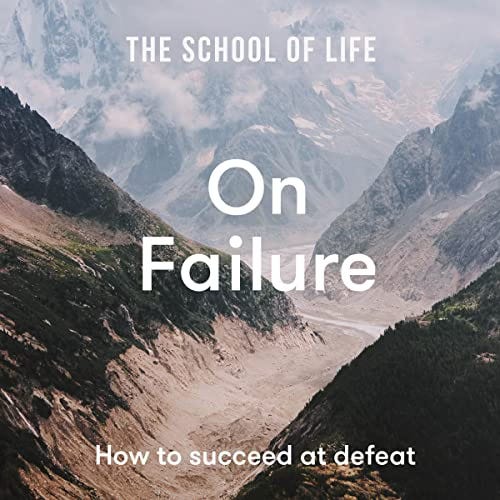
BEL: When I wrote to you, you said you were not a guy who was into self-development.
BEN: Oh, no. I’m such a snob. I’ve been a snob. You know, Bel, I used to work in a bookshop for five years, an independent bookshop, Avid Reader in Brisbane’s West End. When you work in a small family-run bookshop, you have a very close relationship with your customers because it’s a curated service. And when it came to the self-help / self-development section, I just didn’t know anything about it. I think that was why I had maybe an allergy or a preconception to it, mainly because I didn’t actually read that world. And I’m sure a lot of it is not good, but I think that’s in every genre, right? There’s really bad fiction and really good fiction. There’s really bad cookbooks, you know, it’s the whole range. I ignored that section of the bookshop to my peril, but you get to your late thirties and forties and life throws shit at you. And you realise, actually, maybe I need help from a book. I’ve gotten help from books in other ways. Maybe I should literally get help from the help books.
BEL: So tell me about the book you found. What was happening in your life that you thought you might go looking for it? Did it find you in a way, or were you specifically seeking out something?
BEN: I had reached my late 30s. I was 39 at the time. We were just coming out of COVID as well. So I think a lot of the opportunities that I had for work had kind of folded in on themselves or the path ahead was not clear. I was quite cocky and confident in my 20s and 30s about what I wanted to do, how I wanted to get there. But there are many things that were out of our control as we all discovered, one way or another, during COVID. And when certain projects didn’t get up, or certain projects did get up and I would read the bad reviews— I would read the good reviews as well, but the bad reviews just really stay with you, right? They kind of pollute everything.
I just had this sense of failure that I couldn’t really shake off, which is ridiculous because it’s not really seeing things in proportion. But for some reason, my brain, and maybe this is most human brains, really attaches to the failure aspects of things and instead of seeing room for improvement, then wipes the entire thing out as ‘you failed’.
So I’ll give you an example, Bel. This is a really strange example because it’s not to do with my main line of work at all, but I was cast on the TV show Australian Survivor and that was a really nuts experience. It’s not anything to do with my main line of work, it’s not in my wheelhouse, like I wasn’t a super physically fit person at the time. You know, I’m not made for reality TV, but I got cast on this show and I really wanted to do well. And to be honest, I did well by my standards, like I lasted 22 days out there, 22 days without proper shelter, proper food, lost like close to 10% of my starting weight. But I came out of it feeling so ragged and so mentally discombobulated. I was like, oh, I guess I failed at doing that.
But I really needed to find something to kind of console myself over work, over feelings of what I could have done better in that show. And this book, which is The School of Life’s On Failure, just kind of stood out of the bookshop at me like a personal attack (laughs).
So, of course, I had to look at it. I’ve been a fan of, you know, some of Alain de Botton’s work for a while. I think there’s something that appeals to me about finding help in philosophy. You know, my boyfriend did philosophy at university. I’ve got a lot of time for that. I want it rooted in principles and research, whether it’s philosophy or psychology, to give it grounding. It’s not just someone who’s, like, come up with a vibe and wrote a book, you know?
So this is the book that I found and if you read it, it’s intelligent. It doesn’t feel patronising. It feels personal. It feels consoling. I was like, ‘oh, I think I’ll return to this book a lot’, because when you work in the creative industries, everything’s a failure until it actually works. So I thought I had the muscles to be good at failure, but I realised, oh, I actually could do some more training.
BEL: I just finished Helen Garner’s How to End a Story.
BEN: Oh, the diaries.
BEL: The diaries, it’s the third of her diaries.
BEN: Oh, the third. So everything with Murray Bail was falling apart [her soon to be ex-husband, named in her published diary as ‘V’]
BEL: Everything with, yes, with Murray Bail. I just found it fascinating because it’s at the point where she had just published The First Stone and she was getting some flak for it, but also a lot of acclaim. And the whole book is just oozing in this sense of failure that she has, in this sense of not being able to continue.
As you’re reading it, and she’s thinking about whether she’s going to leave her partner and if she can even write, you just feel like yelling at her through the pages, ‘you’re HELEN FUCKING GARNER. Write your book and leave him!’
BEN: Get a grip, Helen!
BEL: Get a grip, Helen! You’re Helen Fucking Garner! And I guess people hearing about, you know, what you were feeling would probably be thinking the same, like, you’re Ben Fucking Law!
BEN: (laughs)
BEL: And yet, and yet you had this sense of failure. And that has been one of the revelations to me, kind of being in proximity to people who have experienced the opposite of failure. Or reading about it, like in Helen Garner’s diary. I always thought there was a point where a sense of failure would end. We would just reach nirvana, and we’re done. There’s no more work to be done.
BEN: That really resonates with me, Bel, because, you know, when I talk to people, you know, especially with a public profile, whose names are synonymous with an incredible body of work, and they just don’t think it’s special. It’s not coming from a place of false modesty at all. Like we will be comparing notes and in moments of vulnerability and complete sheer honesty.
They’ll talk about a work that I love and talk about, you know, all of the flaws that I don’t see, that their readers, their audiences, that their fans don’t see. Or their advocacy and why X, Y or Z failed. And I’m like, ‘you realize your advocacy made this social change, like you actually have a legacy’.
But I don’t know, maybe it’s the way that we’re also asked to present ourselves as well. You know, we don’t necessarily want to present or showcase or be public about failure. It’s often what people say they’re not interested in. You want to curate a kind of… I was going to say persona, but like an image of what’s going well. But I also don’t think that’s lying either. I think that’s also us trying to protect ourselves and trying to remind ourselves of the good so that you can keep going when you have those dark nights of the soul. It’s interesting. I think we all wrestle with it. But like you, it’s always surprising when you hear people you look up to wrestling with exactly the same shit.
BEL: Yeah, and it’s almost like we’re only allowed to present failure narratives as something that has been overcome, you know, and a confession to a feeling of failure in the moment is like, ‘oh, they’re having a breakdown, it’s seen as weakness. We’re not very good at wrestling with it in the moment.
BEN: No, no. So I wrestled (laughs). No, I read this book, spoke to my therapist a lot. But I think it’s important to have those quiet moments where the first thing that’s the challenge is that you even acknowledge that you’re wrestling with it at all. You know, I think most of us would just prefer to deny that that’s even something that we’re concerned about. But if you’re honest about it, it’s like, ‘oh, actually, yeah, I’m struggling with this’. I mean, that’s a hard enough step, I think.
What I really like about this book is everything is like self-contained paragraphs. So it’s quite snackable and consoling. I mean, one of the things I love, but also one of the things I get annoyed about with the School of Life is that there’s no author. Like, you know Alain de Botton is behind it, but there must have been a team on a Google doc, like co-authoring this entire thing.
It’s always strange to me when there’s no author, but when you pick it up, there’s something kind of biblical about it. It’s like you’re receiving the word. It’s just so definitive because there’s no human author behind it. So both annoying, but kind of authoritative as well.
BEL: Are there any passages or themes that really stood out to you, that you felt like, ‘yes, this hits the spot?’
BEN: I remember picking it up and when the introduction was so direct and spoke to me in very plain language, like it wasn’t even story or metaphor or simile, to just say what it needed to say. Can I read the first part to you?
BEL: Please.
BEN: (reads)
One of the many cruel aspects of failure is that when it strikes, it can
feel like the most unusual and particular event. ‘Why did it happen
to me?’ we wonder, ‘Why have I been singled out?’ Our failure looks
to us like a monstrous exception in an area of life dominated by
success – a quite spectacularly strange and rare affliction. We’ve not
only failed, we are – it appears – almost completely alone in having
done so. Everyone else’s marriage is stable, even terrific; all around
us, there are lovers going out on dates and wedding anniversaries
being celebrated. Most people’s jobs are continuing without trouble;
it’s hardly ‘normal’ to be at a loose end at what should be the height
of our career. There’s no evidence that the others around us have
lost command of their reason.
I love that because we all know that feeling. It’s like, ‘Oh my God, everyone else has got it sorted out and we are completely alone in this singular, abject misery and shame’. But of course, when you read that, you realise how ridiculous that is. Of course, that’s a universal experience. The problem is we don’t talk about it with each other because of that shame.
I love that it just pinpointed the specific feeling that we feel is so special to us. But in another way, it’s saying, ‘you’re not so special, dude’. And that’s kind of consoling as well.
BEL: So tell me, just before we finish, what shifted for you?
BEN: After reading the book? I think I felt like I had equipment. You know, that understanding that it’s a very normal part of life, that often your failure isn’t that crushing total end of the world that it should be.
I remember there was one really useful exercise. And of course, like a lot of philosophers, especially School of Life, go back to the Stoics, you know, Marcus Aurelius and things like that. And my friend Bridget Delaney has written a great book about Stoicism. So I’ve got the language around that now, but I’m also like, Oh, that’s just like, that’s just Chinese culture. Sure. The Stoics invented it, but you’re actually just talking about Chinese people.
But I remember there’s a Stoic principle that’s introduced in this book, which is: sometimes it’s not the failure that’s crushing us, but that anticipation or dread of failure. That you feel like you can’t go on, because you’re already imagining or thinking that it’s going to fall apart.
One of the exercises that the School of Life suggests is to imagine the worst-case scenario. Everything fails. You are shunned. You are rejected. You are cast out. You are exiled. And the failure is so total. You’ve been disgraced. Like that’s the ultimate failure, right? Disgrace. It asks you to imagine that, the specifics of that, and asks you two things:
One, how likely is that? And two, could you survive it? And it sounds like a really masochistic, maybe mentally not healthy thing to do, to actually go through that exercise. But I actually find it’s an exercise in logic as well, because when you imagine it, And my imagination is a little too vivid. When I script it in my brain, I realise, oh, it is pretty heightened. It’s pretty ridiculous what you’re imagining, right? Like people booing your opening night, people walking out of the corridors, whatever. Actually, I don’t think that’s likely to happen, but that is the worst-case scenario. And if it did happen, would you survive it?
Well, actually, yeah. You’d probably have like a month of complete nervous breakdown and have a lot of massages and bathhouse bookings and whatever. But you get on with life, and to realise that I think is very helpful. And then you can get on with whatever the fuck you’re doing.