
History author Ryan Butta: How to become a writer, and Australia's shameful, unknown past
99 Problems But a Book Ain't One: 'This was like a revelation, a piece of information that completely freed me from my previous thinking'

I’m Bel Lopez, and this is Story Doula, a newsletter exploring why we tell stories and how we stay connected— with our communities, with each other, with ourselves.
Send me your reflections, suggestions and critical feedback to notes@belindalopez.net. If you’re reading this over email, you can also hit reply.
If you’re having [life] problems, I feel bad for you, son
I got 99 problems, but a [book] ain’t one
With massive apologies to Jay-Z.
99 Problems But a Book Ain’t One is a Story Doula project to remind us of how books, writing and literature can be a balm, a salve, a tonic, as we collectively find ourselves turning to other ways of tuning out and numbing.
This edition features Ryan Butta, my friend and bestselling author of narrative nonfiction books attuned to Australia’s forgotten histories. His chosen book taught him something key about writing— we’ll get to it in a bit.
I met Ryan on a writers’ residency at the rambling, beautiful Bundanon on the NSW South Coast, when we were both working on stories of history in the same region — mine on Papua, and Ryan’s, from the Pacific Islands to Australia.
The manuscript he worked on there is now a book, just released: Blackbirding: A Reckoning with the Australian Slave Trade.
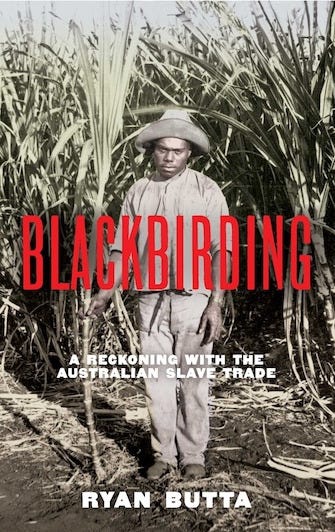
It tells the story of how Pacific Islanders were coerced or forced to work in Australia for half a century and beyond, under horrific conditions. It is about how our country has collectively engaged in a kind of ‘engineered forgetting’ — and continues to turn away from recognising modern slavery today.
I write this having just finished its pages, and coming up for air. There’s a William Faulkner quote that Ryan includes in the earliest pages of the book, that, as he says, stalks the rest of it:
‘Literature has the same impact as a match lit in the middle of a field in the middle of the night. The match illuminates relatively little, but it enables us to see how much darkness surrounds it’.
He goes on to write:
While these pages tell much that has been forgotten, like a match struck in a dark field, they reveal mainly the extent of the darkness that surrounds our understanding of the past, of our own history, of how we all came to be. This is not a reflection on the strength of the light being shone, but on the vastness of the forgetting.
Blackbirding corrects that darkness— not with a small flame but with the blowtorch of Ryan’s forensic, lucid writing, setting alight our amnesia, our wilful forgetting of a practice that was systemic and widespread in Australia. Most shockingly, the book lays out how the beneficiary legacy of this horror is found at the highest echelons of Australian society.
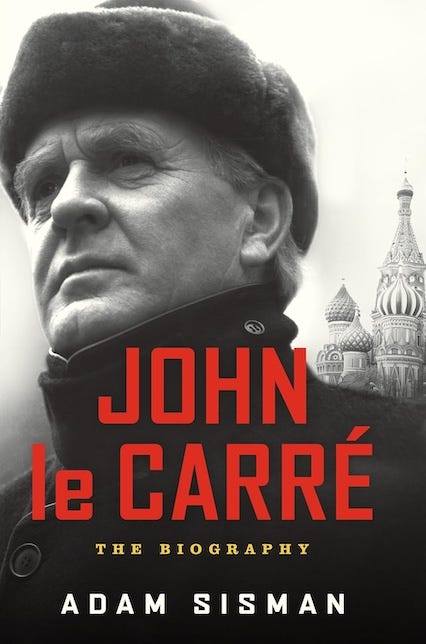
For 99 Problem’s but a Book Ain’t One, Ryan’s pick is a portrait of a writer David Cornwell, known best by his pen name, as the title suggests — John le Carré: The Biography by Adam Sisman.
Bel: What was happening in your life when you discovered John le Carré: The Biography? What problem or question were you facing?
Ryan: It was around the end of 2017, and I had just returned from a ten-year stint living overseas. I had recently completed an MBA but struggled to find work. I ended up taking a job because it was the only job that would take me. I was unhappy with what I was doing and where I was going.
I had always been a voracious reader, but despite taking out the prestigious Creative Writing award at Denman Public School in 1991, I had never written anything or even attempted to. A desire to write had always lurked inside me, a desire that was usually easily suppressed, distracted or ignored.
But it returned, and this time it was different. Rather than a desire, it became a need. Not writing swamped me with guilt. Or perhaps it was the not even trying to write that made me feel guilty. This time, rather than suppress, distract or ignore it, I had to confront the truth: I was scared to try.
That fear stemmed from my reading. I would read a book and think, “I could never write like this”. When I started to put lines down on a page, I only proved the accuracy of that thought. I could not produce anything that came close to the writing that I admired.
It wasn’t until I read John le Carré: The Biography by Adam Sisman that everything changed.
Bel: Can you share some quotes that stood out to you, and tell me why they were important?
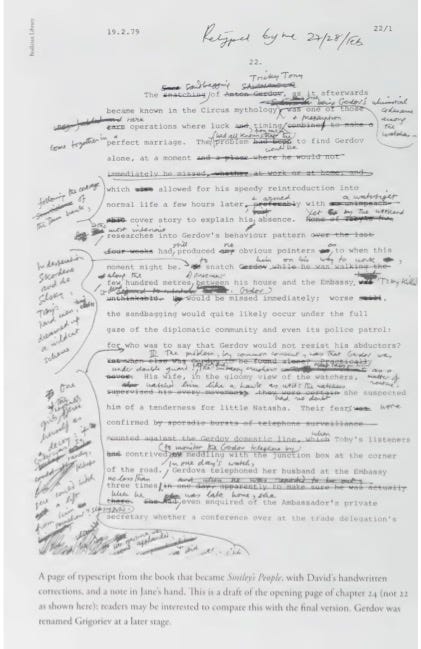
Ryan: It wasn’t a quote that helped me but a picture that was included in the book. It was a page from a typewritten early draft of one of Le Carre’s books. But what grabbed my attention were the revisions. I could clearly see in the draft where he had used a verb and later come back to it, crossed it out in pencil and replaced it with a stronger verb. It revealed the process that Le Carré had gone through as he built the sentence.
Bel: What changed for you after reading John le Carré: The Biography?
Ryan: This was like a revelation, a piece of information that completely freed me from my previous thinking. I realised that not only could I not write like Le Carré wrote, neither could Le Carré. At least not on the first attempt. First drafts are awful, even for someone who many consider a master of his craft. I now had permission to sit down and write and hate what I was writing but not care. Later, I could come back with my pencil and cross out the bad stuff and word by word begin to build better sentences. Before this, I genuinely thought that what I read on the page of a book is how it had come out of the author’s mind. I saw the author as bestowed with a genius for words that I could never hope to attain. I now know that this is not the case and that provides the freedom to sit down and write a draft from start to finish, comfortable that all of it, some of it, or none of it can always be scrapped, reworked or erased for all time. That is incredibly liberating.
Bel: What does the book mean to you now?
Ryan: I still think about that photo. And it remains the piece of advice I always give people who ask how to become a writer. There is only one answer to that: write. Write knowing that what you produce will not be perfect or even pleasant. That is true for you and it is true for John Le Carré. But with editing, you can make it start to approximate something you are happy with. Too many aspiring writers stop writing before they even have something to edit. You can’t edit a blank page.
Thank you again to Ryan Butta. He is impressively free of social media, but you can find Blackbirding at your local independent bookstore!
An unexpected discovery in the book was the beautiful foreward by (Waskam) Emelda Davis, a leader of the Australian South Sea Islander community, among her many achievements, and descendant of men and women who were stolen into blackbirding. As she writes, ‘truth-telling is not comfortable work’.
99 Problems But a Book Ain’t One: Suggestions open!
If you have a favourite writer, artist, muse or mentor who you’d like to see in 99 Problems, email me at notes@belindalopez.net. It can be a secret vote, or your name acknowledged in their edition!
Send me your reflections, suggestions and critical feedback to notes@belindalopez.net.
If you’re reading this over email, you can also hit reply.