
The past is back again
Populists, 'boat people' and why we need to remember it all

I’m Bel Lopez, and this is Story Doula, a newsletter exploring why we tell stories and how we stay connected— with our communities, with each other, with ourselves.
The populists are back. The 1920s and 30s have returned. The first time around, it was all so new. we were taken by surprise, disoriented, knocked off our feet, terrified, cowed. This time we have no excuse. We know the populists’ game plan. And we know that unless we show the strength to face them down, disaster will follow.
Repeat: A warning from history, Dennis Glover
I’ve been doing a lot of thinking about remembering lately, watching Pauline Hanson’s Press Club address, screeching for a mythical monocultural Australia, among other things. To be honest, I’m always thinking about remembering— a lot of my essays and documentaries and research over the years have been obsessed with how the ghosts of history come back for us, again and again. That idea lies at the heart of the book I’m working on right now.
I’ve started reading Dennis Glover’s Repeat: a warning from history, which is shaping up as an easily digestible primer (or reminder, for students of history), for what the road ahead looks like, if left unchallenged.
For a few years, Australians have been allowed to daydream into the fallacy that the return to populism was something that was happening elsewhere- in Europe, in the United States. But now, in our regional neighbourhood, in Indonesia, and here in Australia, the evidence of a new political order is hard to ignore.
My dear friend and writing partner Vannessa Hearman is someone who has thought about remembering a great deal. She’s a historian of South East Asia whose work has deeply engaged with how we remember violence, in Indonesia, East Timor, and beyond— and what, sometimes, people need to forget, in order to go on.
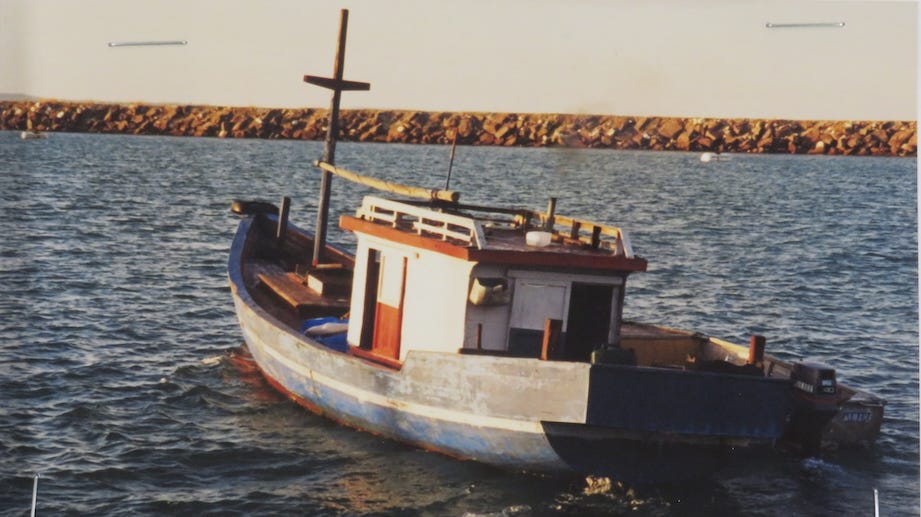
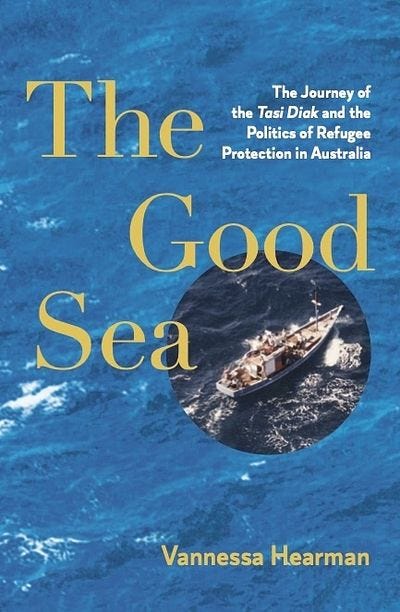
Her book The Good Sea has just been released, and it does its own remembering — about the East Timorese refugees who arrived in Australia on a boat, the Tasi Diak (The Good Sea) in 1995. These were political activists who wanted Australians to know about East Timor’s struggle for independence.
Yet when they arrived to Australia, they faced Labor politicians who had just introduced mandatory detention of boat arrivals and were trying to deny refugee status to the East Timorese asylum seekers.
The Tasi Diak voyage is important too because, today, the mobility of people exercising their agency to find safety and wellbeing has been increasingly restricted and criminalised the world over. The nation’s migration laws have changed so much that if this voyage were to take place now, the passengers would be sent to offshore detention camps and unlikely ever to be resettled in Australia.
The Good Sea, Vannessa Hearman
I’ve been delighted to track The Good Sea’s upward trajectory in media outlets. It’s also garnered excellent reviews in places like Inside Indonesia here, and Sydney Arts Guide.
Vannessa’s book is launching in Mebourne on Thursday June 25, in Sydney on Thursday July 2, and in Newcastle on Monday July 6.
99 Problems But a Book Ain’t One
In this special installment of 99 Problems But a Book Ain’t One, Vannessa answers my questions about a book that changed her. She’s chosen the 2006 Man Booker-winning novel, Kiran Desai’s The Inheritance of Loss.
Bel: What was happening in your life when you discovered The Inheritance of Loss? What problem or question were you facing?
Vannessa: Kiran Desai’s Inheritance of Loss was striking to me because of its depiction of how communities live through and survive violence, including structural violence, going on with their lives despite the gaps, absences, and the pain of the past. Although it was set in the foothills of the Himalayas in the border region between India and Nepal, many of its themes are universal.
At the time, I was writing my doctoral thesis on the anti-communist violence in East Java, Indonesia, in 1965-68, a violence orchestrated and led by the Indonesian army under General Suharto, who went on to rule Indonesia for 32 years. I was dealing a lot with the varying degrees of willingness among survivors to recount their experiences. For example, while I spoke to many former political prisoners about their leftist political activism, their imprisonment and their lives afterwards, beyond former political prisoner circles, the willingness to remember was much more mixed, including in my own family. Remembering is an active choice. I was interested in exploring why survivors, who could be classified as bystanders and eyewitnesses, were less able or willing to talk to me about how they got through it.
Bel: Can you share some quotes that stood out to you, and tell me why they were important?
Vannessa: My doctoral thesis, completed in 2012 at the University of Melbourne, opened with this quote:
These years were blurry for many, and when they came out of them, exhausted, the whole world had changed, there were gaps in everything – what had happened in their own families, what had happened elsewhere, what filth had occurred like an epidemic everywhere, in a world that was now full of unmarked graves – they didn’t look, because they couldn’t afford to examine the past. They had to grasp the future with everything they had.
Kieran Desai, The Inheritance of Loss, Grove Publications, 2006, p. 338.
The words ‘unmarked graves’ inspired the title of my first book. It was often mistakenly thought that the title of my book referred only to Indonesia, but of course, it doesn’t. The world is full of unmarked graves of those who were killed in wars and other violent conflicts. Even the oceans and seas today are replete with unmarked graves as governments allow refugees to perish in the Mediterranean between Africa and Europe. The Inheritance of Loss taught me that the landscape remembers, but humans may choose to forget, even for a moment, so they can go on.
When I read Inheritance of Loss, particularly the theme of separation that emerged through the experiences of some of the characters, it helped me understand how some families had to endure and accept being separated from their loved ones for many years, despite the pain. I came to understand why forgetting was also an important way of dealing with political violence or with separation arising from immigration, the political, social and economic bases of which are all too often difficult to untangle. Psychologically, forgetting and a certain degree of acceptance allow us to move forward, even if deeply damaged and in pain within. Not wanting to remember is a protective mechanism that we need to honour as much as remembering. In the course of my research, I developed the term ‘activist remembering’ to encapsulate my experience of speaking to many former political prisoners in Indonesia who, after the end of the Suharto regime, recounted their stories as part of their campaign to demand the reopening of the 1965-68 mass violence, for public discussions and legal accountability to occur.
Bel: What changed for you after reading it?
Vannessa: I gained a deeper appreciation for the collective need to move forward while holding space for pain. The book also reminded us of the need to hold out hope for reunion and the rediscovery of joy. When what had seemed an unlikely reunion occurred at the end of the book, the unfettered joy with which two of the protagonists seized one another, literally jumping for joy together, showed me that, for survivors, hope does not diminish over the many years that lapsed. We don’t stop loving someone because they are far away. We don’t stop demanding justice because we have had to be silent for a while. In this way, I learnt to appreciate, consider deeply, and reflect on how people deal with the experience of political violence and its aftermath.
Bel: What does The Inheritance of Loss mean to you now?
Vannessa: Thinking back to the theme of the landscape as a sentinel of memory, we can also see that it’s possible to set aside the physical markers of violence for a while, for them to reemerge later. The landscape holds the potential for re-membering. The creation of markers, artworks and literature to remember the victims of the 1965-68 mass violence in Indonesia has occurred thanks to ‘activist remembering’ after the democratic transition, as well as to what the landscape holds, as shown in the art of Dadang Christanto and Leyla Stevens, for example.
Remembering, however, has also been possible thanks to the quiet memory-keepers who keep memories alive ‘quietly’ until the right moment comes, once the years have gone by. These include, for example, those who hide archives and books in the attic or live in exile abroad, hoping to return to their homeland one day. Justice has not been served for the hundreds of thousands who were killed or imprisoned without trial in Indonesia, but remembering, and yes, jumping for joy when the time comes, denotes survival and victory of a certain kind.
Thanks again to Vannessa, and catch The Good Sea launching in Mebourne on Thursday June 25, in Sydney on Thursday July 2, and Newcastle on July 6.
Paired links:
— Pig Feast, the documentary film about environmental destruction and colonialism in West Papua that I helped launch in Sydney a few months ago, has received a lot of media attention for its impact in Indonesia, and the ramifications for those involved in the film.
It’s now free to watch online, with English subtitles. The film documents the largest deforestation project in Indonesia, and raises concerns about freedom of speech and political, military and business corruption, with Australian links. I urge you to watch it:
— West Papua’s first female novelist, Aprila Wayar, died last year — Aprila was a friend and generous guide for me over the years. A night of remembering and a fundraiser for her children is being held in Melbourne this coming Wednesday 24th June, also available online. You can get tickets here.
As always, love to hear your thoughts and ideas. Send me your reflections, suggestions and critical feedback to notes@belindalopez.net. If you’re reading this over email, you can also hit reply.
Bel